In
Lorraine Hansberry’s drama of “A Raisin in the Sun”, readers can analyze the
effects of society’s influence on the female characters. Lena (Mama), Ruth and
Beneatha experience levels of misogyny. According to Anthony Barthelemy in his critical
essay, “Mother, Sister, Wife: A Dramatic Perspective” he says, “No matter what
Hansberry's intentions, to those who subscribe to this image of black women,
Lena, Ruth and Beneatha all seem to participate in that emasculating tradition”.
This tradition which Barthelemy mentions is a product of society. However,
these women experience and react differently to it. The gender roles and
prejudice that is enforced on them through family and close friends is not seen
as abnormal because these ideals are mutually accepted by the American society
around them.

The gender roles which are followed are
affected by society’s influence amongst each generation that appears in this
literature piece. Mama/Lena is the mother/mother-in-law, widow and grandmother who
represents the oldest generation in the home, resonating the traditions of the
nearby past. As her son Walter phrases it, “You the head of this family.
You run our lives like you want to” (Hansberry 764). Mama is like the strong
pillar that helps to hold their household together. She does not feel that she
needs to acquire permission from anyone and in a sense feels more liberated
than Ruth or Beneatha.

To a
certain degree, Lena feels more freedom that Ruth or Beneatha because her
desires and actions conform within society’s norms; there is an exception in Act
II where she breaks through cultural barriers by purchasing a house within a
white community (Hansberry 762). This factor may be because she is an older and
widowed woman whose children still live at home and under her roof. This
decision of buying a house in a white community is a turning point for Lena where
she decides not to conform to the prejudices that exist towards her and her
family, not only as a question of gender, but their ethnicity. By this action,
Lena and her family gain pride and dignity in their identity, despite societal
influence which has been working against them.

Although
Lena typically has the last say, Ruth also has a level of influence within the
home. While she does not seem as traditionally religious as her mother-in-law,
Ruth does not seem as shocked at Beneatha’s negation of the existence of God. She
sympathizes with her mother-in-law because she too is a mother and understands
what Beneatha’s opposition to the idea of God means to Lena. She seems to adopt
a motherly tone with her younger sister-in-law by chiding her, “You think you a
woman, Bennie—but you still a little girl.
What you did was childish—so you got treated like a child.” Not only
does Ruth act like the second mother of the home by cautioning Beneatha on her
attitude towards her brother, “Don’t be so nasty Bennie” but she also defends
her, “Walter Lee, why don’t you leave that girl alone…?” (731-732). Ruth appears to
stand somewhere in between Lena and Ruth. Ruth seems to follow some traditional
convictions because as a married woman, society makes it seem natural to be a
good natured, pacific, and submissive wife.
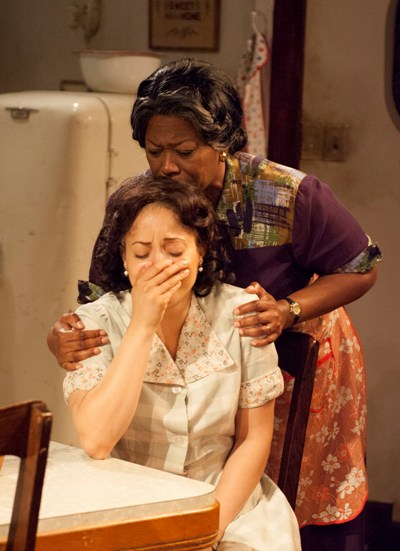
Despite following society’s norms
for being a good housewife, Ruth experiences no support from her husband, whose
words are demeaning towards her. In today’s world, Walter Lee would be
considered and emotionally abusive husband. He complains that she does not back
him up (Hansberry 730). He also uses this to generalize all black women saying,
“That is just what is wrong with colored women in this world” (731). Walter
constantly yells at Ruth and demonstrated indifference when he learns of her
plans to abort their unborn child (752-753). This form of misogyny that Walter
uses is what he has learned about society, brainwashing him that woman and wife are men's property and she is supposed to acknowledge all his whims without receiving any consideration from him. Enduring his
insensitive words, Ruth represents the stereotypical perfect housewife: humble, submissive and with a quiet spirit. She simply accepts his cruel words, answering, “Well, being a
colored woman, I guess I can’t help myself none” (731). Despite the issues that
exist between Ruth and Walter, the reader can see that Ruth respects her
husband’s male dominance willingly, unlike Beneatha.

Beneatha who is a college student, a
daughter, sister, and an aunt experiences many pulls of what she ought to be.
This contributes to her character of finding her identity. She tries a number
of things from guitar lessons and horseback riding (737-738). According to Diana Mafe in her critical essay
“Black women on Broadway: the duality of Lorraine Hansberry's A Raisin in the
Sun and Ntozake Shange's for colored girls” these actions point out “her search for a self-defined identity, something that her mother
and sister-in-law (women of an older generation) find amusing” (Mafe). Beneatha
is dissimilar to Ruth in that she is not willing to follow a man blindly. “Beneatha
consistently rebuts the sexist male voices in the play” (Mafe). Throughout the
play, the reader can see how Beneatha is the female character that is most
independent, and as a consequence, the one who encounter more of society’s
limitations and finds them stifling. According to Barthelemy, “Beneatha accepts the authority of no one. Only
when her brother demonstrates pride and dignity does she respect him as a man,
but she never surrenders her ambition or assertiveness” (“Mother, Sister, Wife:
A Dramatic Perspective”). She also does not surrender her goals or opinions to
men in general, even to those who she feels an attachment to. Unfortunately,
many of her goals such as becoming a black doctor and her feminist opinions go
against the grain of society.

Beneatha experiences the
pressure to conform to the idea that a woman’s is to love a man and be
supportive, similar to what Ruth is currently living. Beneatha “embodies the
"new" black woman” and “represents the intellectual voice of feminist
debate” (Mafe). Beneatha represents a new age for black women. From her suitors
George Murchison, no level of intelligence or personal feelings are required;
instead he wants “a nice…simple…sophisticated girl” (Hansberry764). He wants
her to turn off her brain and become a pretty commodity for him. As I wrote in
my essay “A Reflection of the Characters in ‘A Raisin in the Sun’”, “Not only does Murchison serve as an echo to what her brother Walter
tells her that she ought to be, but he is also reverberating what the majority
in society still believe about what a woman’s role is” (Salazar 2). On the other hand, her second suitor Joseph
Asagai supports her dreams, but he also believes that a woman’s purpose is to
love one man—particularly him (Hansberry
764).

In the of the play both Lena and
Beneatha appear to cross certain societal barriers, whether it is purchasing a
home in a white community or trying to conform to the norms of a society that
does not accommodate their race or gender. However, both of them represent
strong women who are proud of their identity as black women in the United
States and act accordingly. Lena represents
an older time that is taking steps that will lay a foundation for the next two
generations, while Beneatha represents the voice of change that will carry on
this legacy. Ruth represents the majority which do not take large leaps towards
progress for their gender or race, but whose opinions are not in opposition,
therefore contributing their support.
Works Cited
Barthelemy, Anthony. "Mother, Sister, Wife: A Dramatic Perspective." Southern Review 21.3 (Summer 1985): 770-789. Rpt. in Drama for Students. Ed. Elizabeth Thomason. Vol. 12. Detroit: Gale, 2001. Literature Resource Center. Web. 3 May 2015.
Hansberry, Lorraine. "A Raisin in the Sun." Literature The Human Experience Reading and Writing. Ed. Richard Abcarian and Marvin Klotz. 11th ed. Boston: Bedford/St. Martins, 2013. 724+. Print.
Mafe, Diana Adesola. "Black women on Broadway: the duality of Lorraine Hansberry's A Raisin in the Sun and Ntozake Shange's for colored girls." American Drama 15.2 (2006): 30+. Literature Resource Center. Web. 6 May 2015.